
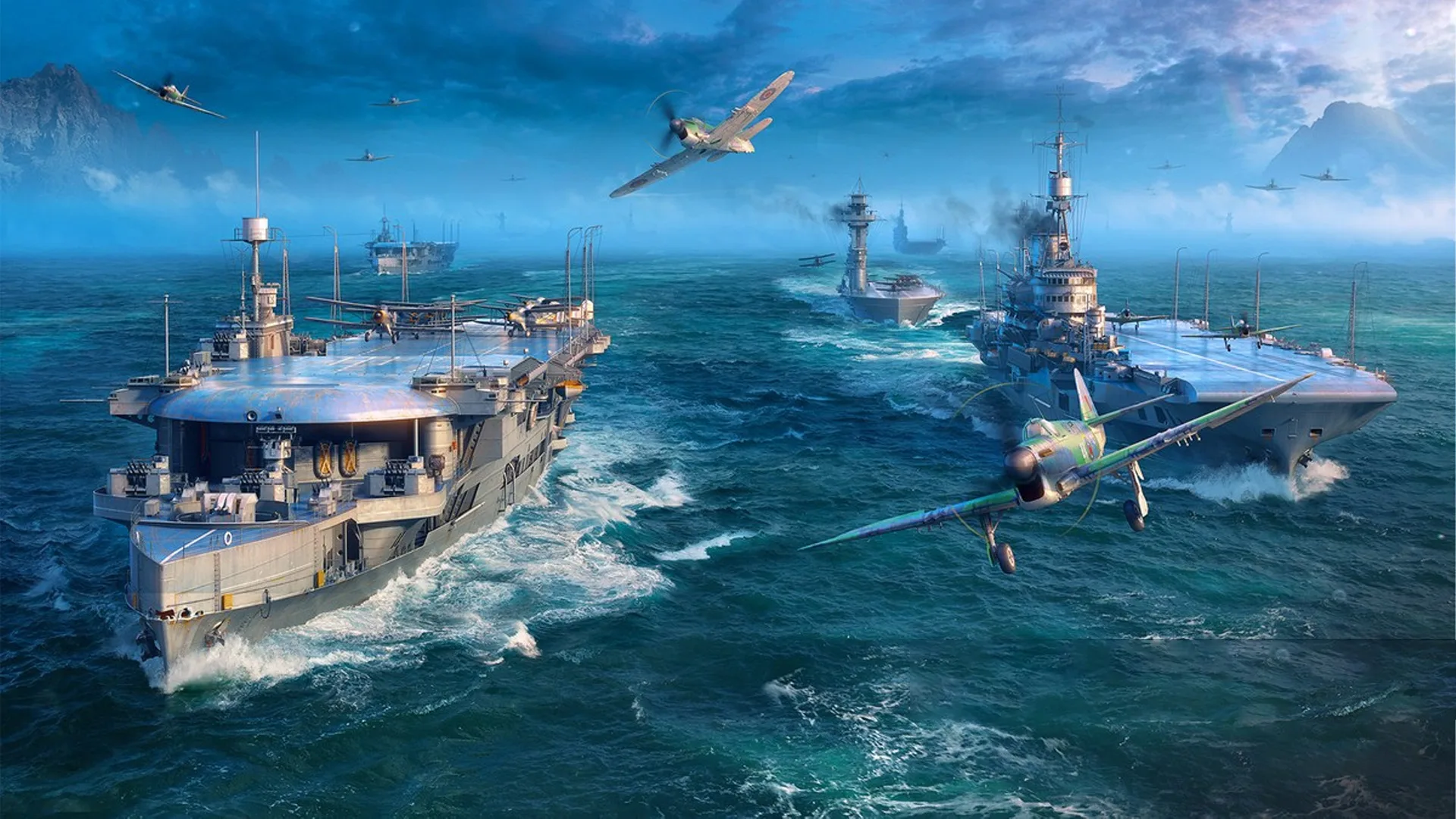
Aircraft Carriers in World of Warships play nothing like any other ship class. Instead of aiming guns directly at enemies, you launch and manually fly squadrons of aircraft that attack from the air. The carrier itself sits far from the fight while your planes do the work. Learning how to play Carrier in World of Warships means learning two separate jobs at once: flying attack runs effectively and reading the battlefield for your team.
How carriers work: the core loop
You control one squadron at a time. The basic loop is:
- Launch a squadron (press 1, 2, or 3 twice — attack aircraft, torpedo bombers, dive bombers)
- Fly toward your target using WASD
- Left-click to enter attack mode — a small group breaks off to attack
- Left-click again to release your payload when on target
- The attack group rejoins the main squadron; fly another pass or press F to recall and relaunch fresh planes
While a squadron is airborne, your carrier moves on autopilot following the last waypoints you set. You control either your planes or your ship — not both at the same time.
Controls at a glance
| Key | Action |
|---|---|
| 1 (press twice) | Launch attack aircraft |
| 2 (press twice) | Launch torpedo bombers |
| 3 (press twice) | Launch dive bombers |
| W | Increase speed / boost |
| S | Decrease speed / air brake |
| A / D | Turn left / right |
| F | Recall squadron to carrier |
| Left-click | Begin attack run |
| Left-click again | Release payload |
The three aircraft types
Attack aircraft
Attack aircraft carry rockets — the easiest weapon to aim. The reticle stabilises fast, there’s no arming distance, and the planes approach at high speed. HE rockets work best against destroyers and lightly armoured targets. AP rockets deal better damage against cruisers where HE would bounce.
Attack aircraft are the best tool for hunting destroyers — fast approach, no arming requirement, and destroyers have no citadel to hide behind.
Torpedo bombers
Torpedo bombers are the primary damage dealers. The attack cone narrows as you hold the approach — the tighter the cone, the more accurate your drop. You must account for arming distance: torpedoes dropped too close will pass under or through the target without detonating. Start the run from sufficient distance and aim where the ship will be, not where it is.
Torpedo bombers deal consistent damage against battleships and cruisers. They’re harder to aim than rockets but much higher damage potential.
Dive bombers and level bombers
Dive bombers drop bombs in a falling arc — harder to aim than rockets, rewarding when you land hits. AP bombs from Japanese carriers penetrate battleship and cruiser deck armour for massive damage. HE bombs from US carriers deal fire damage and module destruction.
Level bombers use a different aiming system — the reticle moves across the target area and you release at the right moment. Generally easier to use than dive bombers but lower peak damage.
Your primary job: spotting
Damaging enemies is satisfying, but your most important contribution is spotting. Your aircraft give the entire team vision of wherever they fly. An enemy destroyer invisible to every ship on your team is instantly spotted when your planes pass overhead.
At the start of every match, fly toward the caps and spot enemy destroyers before they set up in smoke. This is the highest-value action you can take in the first 3–4 minutes. Your team cannot shoot what they haven’t seen.
Beyond early game spotting:
- Keep flying around flanks and forward positions so your team has constant vision of enemy movements
- When an enemy ship is trying to reset a cap, fly over it to spot it for your team
- If your carrier is under threat, fly toward the attacker to spot it and warn your allies
Even if your attack runs aren’t landing well, consistent spotting will make you a positive contribution to every match.
Positioning your carrier
Your carrier is nearly defenceless against other ships — cruisers and destroyers will destroy it very quickly. Standard carrier positioning:
- Stay 15–20 km from the nearest enemy — close enough for planes to reach targets in reasonable time, far enough that forward ships can’t push you
- Hide behind islands where possible — reduces the chance of incoming fire from long-range battleship shots
- Move after launching — never stay stationary; if your position becomes known, move to a new location before your next launch
- Park near allies — friendly ships protect you from destroyers that try to hunt you down
While your planes are airborne, use the tactical map (M) to set carrier waypoints without recalling the squadron.
Anti-aircraft: what to expect and how to avoid it
Every ship has AA guns that damage your planes as you fly through them. Three aura ranges — long, medium, and short — deal progressive damage as you get closer.
To reduce AA damage:
- Come in from behind the target — approach from the blind side or from a direction where fewer ships can engage your planes
- Avoid flying over clusters of ships — AA stacks when multiple ships are near each other; groups of 3+ ships will shred your planes fast
- Use islands — flying along the side of an island breaks line of sight to some AA ships
- Don’t linger — complete your attack run and fly away; circling a target repeatedly gives clustered ships time to reload and focus
- Recall early if the squadron is badly depleted — a half-strength squadron does half the damage; cutting losses keeps your attack frequency higher
Ships with Defensive AA Fire active are extremely dangerous — avoid attack runs on ships that have just activated it.
Practice before competitive
Carriers have the steepest learning curve of any class. The timing on torpedo runs alone takes multiple matches to internalise. Use co-op battles and the training room to practice attack timings against stationary targets before playing randoms.
How do aircraft carriers work in World of Warships?
Carriers launch and control one aircraft squadron at a time. You fly the planes manually, perform attack runs by left-clicking to enter attack mode and left-clicking again to release the payload, then either re-run or recall the squadron. Your carrier moves on autopilot while planes are airborne.
What is the hardest part of playing a carrier?
Torpedo bombing. The attack cone aiming, leading a moving target, accounting for arming distance, and avoiding AA clusters are all happening simultaneously. Rocket strafing is far easier — beginners should focus on getting attack aircraft runs right first.
Should carriers focus on damage or spotting?
Both, but spotting comes first. A carrier that deals less damage but keeps enemy destroyers spotted all match contributes more to a team win than one that farms damage while the enemy DD steals all three caps unseen.
How do you avoid getting your planes shot down?
Approach from directions where fewer ships can engage. Avoid ship clusters. Don’t loiter over targets — attack and withdraw. Recall early if the squadron is badly damaged. Never fly through a Defensive AA Fire activation.
Can a carrier be destroyed in World of Warships?
Yes. Carriers have significant HP but are almost defenceless at close range. Destroyers that find your carrier will kill it quickly. Keep your distance from the frontline, stay behind islands, and keep an eye on the minimap for ships trying to hunt you. If you’re spotted, move immediately.